Azerbaijan a country where mountains, desert and sea coexists having its borders with four countries and the sea. From cobblestone streets, fortress walls, Zoroastrian fire temples to Islamic architectures, from streets once passed by the Silk Road traders to the futuristic curves of the HeydarAliyev Center it has charm in its contrasts.
My journey began in the charming city of Muscat, Oman’s capital, as I boarded an Air Arabia flight heading to Baku, the capital city and heart of Azerbaijan. The total flight time was just under four hours, with a brief stopover at Sharjah International Airport. With a two-hour transit, everything moved swiftly and smoothly — the airport staff were ready and helpful, guiding transit passengers efficiently. Since we were just connecting, there was no need to pass through immigration again, which made things even more effortless.
As we touched down in Baku with our approved visa at hand, the experience at the airport immigration was pleasant and smooth. Immigration was quick, and once outside, I was immediately struck by the first impression of the modern design of the HeydarAliyev International Airport. With two terminals, the airport is named after HeydarAliyev, Azerbaijan’s national leader and its first president post-independence. Many landmarks and roads in the country are named after him and his legacy was visible all across the country.
Our driver was already waiting for us outside who was friendly and good in English. The road from the airport into the city took us through Baku’s main avenues, lined with grand, tall buildings on both sides with eye catching architectures gave us our first real taste of the city’s modern vibes. After arriving at the hotel, we paid the total tour cost in US dollars — as was agreed earlier with our tour company and checked into our room for a quick rest.
Not one to stay in hotel room for too long in a new beautiful city, I soon stepped out for a quick exploration of the area around the hotel. My normal routine while entering in a new country is always mapping out the essentials like ATMs, restaurants, and nearby hypermarkets. It’s always comforting to know where I can get my basic requirements nearby, especially when traveling.
Our hotel was just a short walk away from famous Nizami Street, and being at the center of the city has its own advantages always. Main Nizami Street is a vibrant, scenic, and pedestrian only avenue full of life. From cozy restaurants to street performers, from designer shops to vendors selling delicious street food – it’s a place where we get the city’s nice touristic vibe. The street leads into the iconic Fountain Square, a popular meeting spot surrounded by bars, pubs, and clubs, making it the perfect place to enjoy the city’s dynamic nightlife.
Azerbaijan itself has a fascinating geography being located on the western shore of the Caspian Sea and spanning two continents – Asia and Europe. Being a former Soviet republic, it’s uniquely situated between Eastern Europe and Western Asia, also often included in the Middle East due to its borders with Iran and other regional influences. It shares its borders with Georgia to the northwest,
Armenia to the west, Russia to the north, and Iran to the south, while the beautiful Caspian Sea embraces its eastern shore. The official language is Azerbaijani, and the local currency is the Azerbaijani Manat (1 USD is roughly 1.7 Manat). Interestingly, the 200 Manat note features an illustration of the futuristic HeydarAliyev
Center on one side and has a map of Azerbaijan on the other — a small symbol of national pride. Azerbaijan gained its independence from the Soviet Union in 1991, and today, it is also referred as the nicknames “The Land of Fire” and also as “The City of Winds.” Exploring Baku – A Blend of History, Modernity, and Mesmerizing Views
Azerbaijan offers an electronic visa (e-visa) facility, which turned out to be a very convenient option for Indian travelers like me. We received our single-entry visas within just three working days of applying online. The visa is valid for 90 days, with a maximum stay of 30 days. It’s highly recommended to carry a printed copy of the e-visa to present upon arrival in Azerbaijan. Before embarking on the trip, my initial research revealed something quite striking—gas and oil contribute to about two-thirds of Azerbaijan’s GDP, placing it among the top ten countries most reliant on fossil fuels. In fact, gas and oil account for 90% of its export revenue and 60% of the country’s finances. I have the feeling that oil boom has clearly left a significant imprint on Baku’s skyline and has played a major role in its modern development.
Day 2:
Little Venice and the Baku Boulevard:
After an overnight rest and a heavy breakfast at the hotel, we set off on our Baku city tour with an English-speaking Azerbaijani driver. I’ve noticed during my travels to various countries that tour companies often provide English-speaking drivers, but they usually don’t offer much information on the attractions. They just drop and pick up tourists from the attractions. Tourists like me often have to research and explore on their own, divide our time among the attractions as per our own interest which, to be honest, I don’t mind. There’s something enjoyable also about discovering places at your own pace.
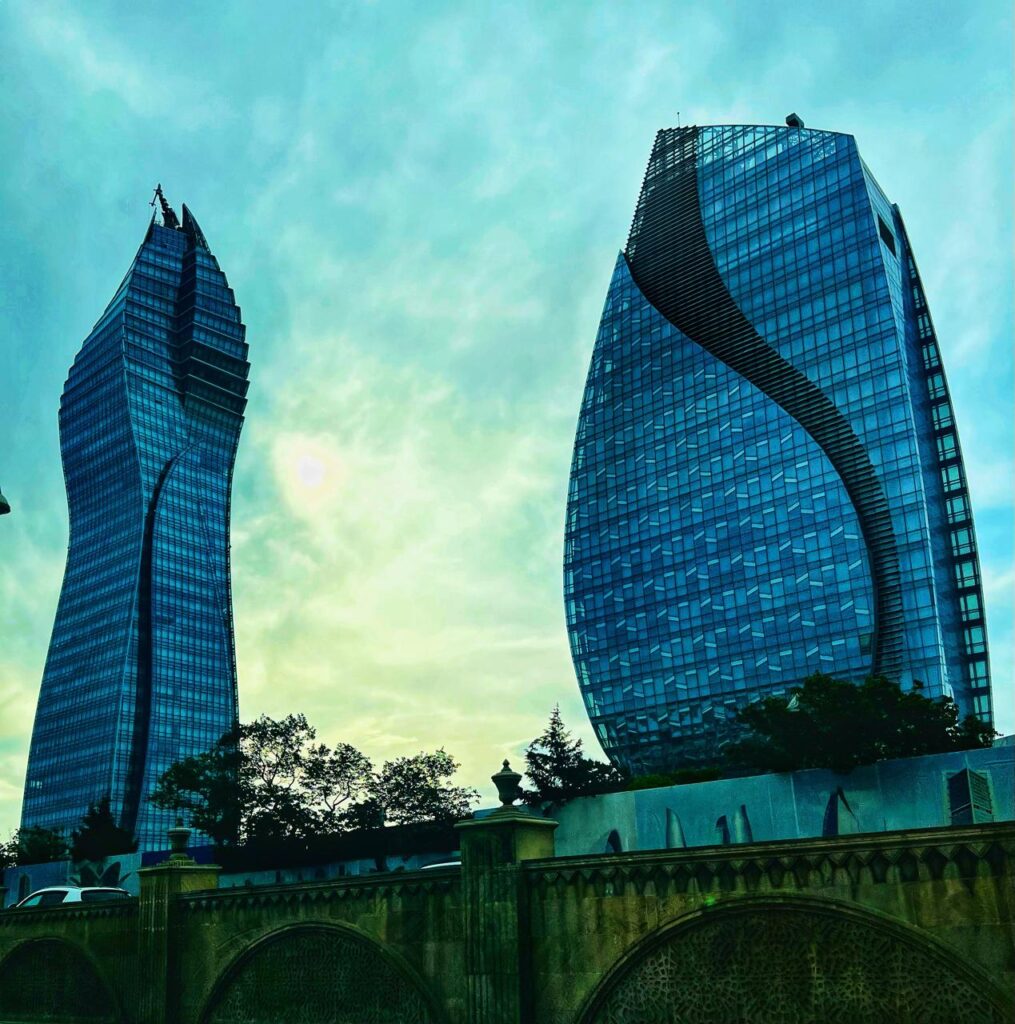
Driving through the main streets of Baku, I was instantly drawn to the massive, elegant buildings lining both sides of the road. Some of the modern high-rises had such unique and striking architecture that I couldn’t resist capturing videos from the car. Our first stop was Highland Park, located on the slopes of the Baku hills. This is the highest point in the city and offers a breathtaking panoramic view of Baku. From the park, the view of Baku Bay, the Caspian Sea, Baku Boulevard, and the city’s skyline—especially the iconic Flame Towers and the Baku Ferris Wheel—was absolutely mesmerizing. Standing there, I could almost feel the pulse of the city’s history blending with its modern face.
The park had a serene vibe and well-landscaped, with neat gardens—an ideal place to start our trip. Most tourists were busy taking photos, including me! There’s also a lovely restaurant here called Manzara Sky, which looked like a great place to relax and enjoy the view.
One of the most moving parts of the visit was walking through Martyrs’ Lane, a solemn memorial dedicated to those who lost their lives during the 1990 Black January tragedy. A long wall adorned with the names, photographs, and dates of birth and death of the martyrs, along with fresh red roses laid on few marble slabs, created a truly emotional atmosphere. The Eternal Flame Memorial had continuous gas flare and the television tower at the back perfectly framed through its architectural opening, was a photographer’s delight.
To reach Highland Park, we climbed around 100 steps from the parking area and it was worth the effort. While coming down, we chose the road beside Martyrs’ Lane, which made for an easier descent avoiding the steps.
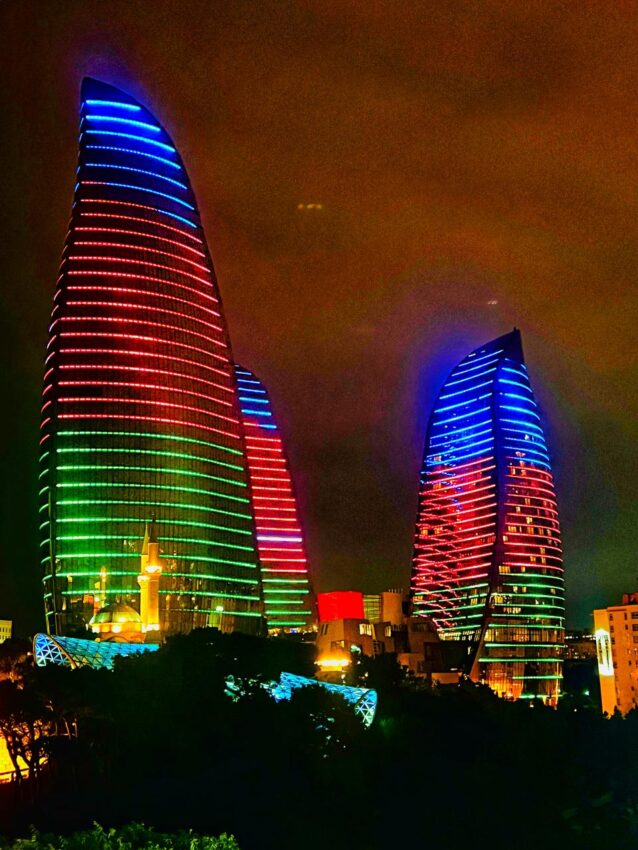
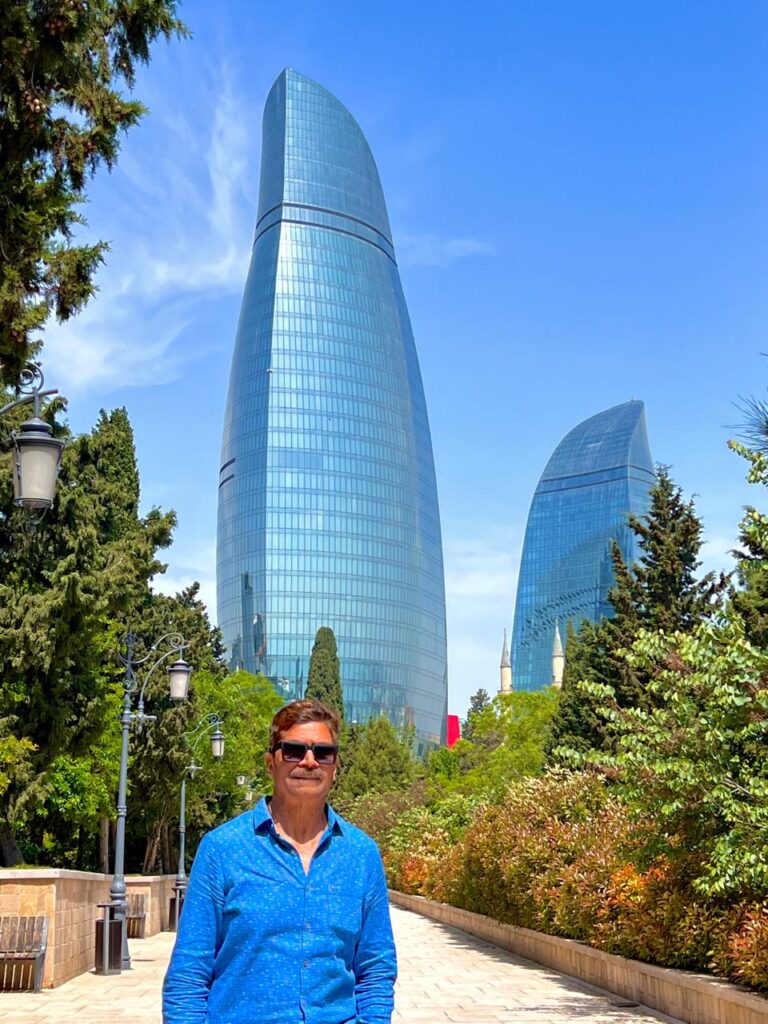
Not far from the park are the Flame Towers, perhaps the most iconic landmark of Baku. At night, their reflective glass façade lights up, looking like flickering flames which is an incredible sight! Designed to represent the element of fire, the trio of pointed towers houses the luxurious Fairmont Baku hotel, a five-star property with over 300 rooms and even a movie theatre. If time permits, I highly recommend that tourists visit Highland Park again after sunset to experience the breathtaking night view of downtown Baku and the Flame Towers, which are beautifully illuminated in changing colors. I did this myself to enjoy the stunning scenery under the lights and noticed that there were actually more visitors in the evening than during the daytime.”
We also stopped by Deniz Mall, a uniquely designed shopping destination located on Baku Boulevard, right by the Caspian Sea. The mall stands out for its architecture, bound to attract the tourists and is a popular spot for both shopping and dining. It features several international retail stores and a range of restaurants, making it a good spot to unwind for a short break.
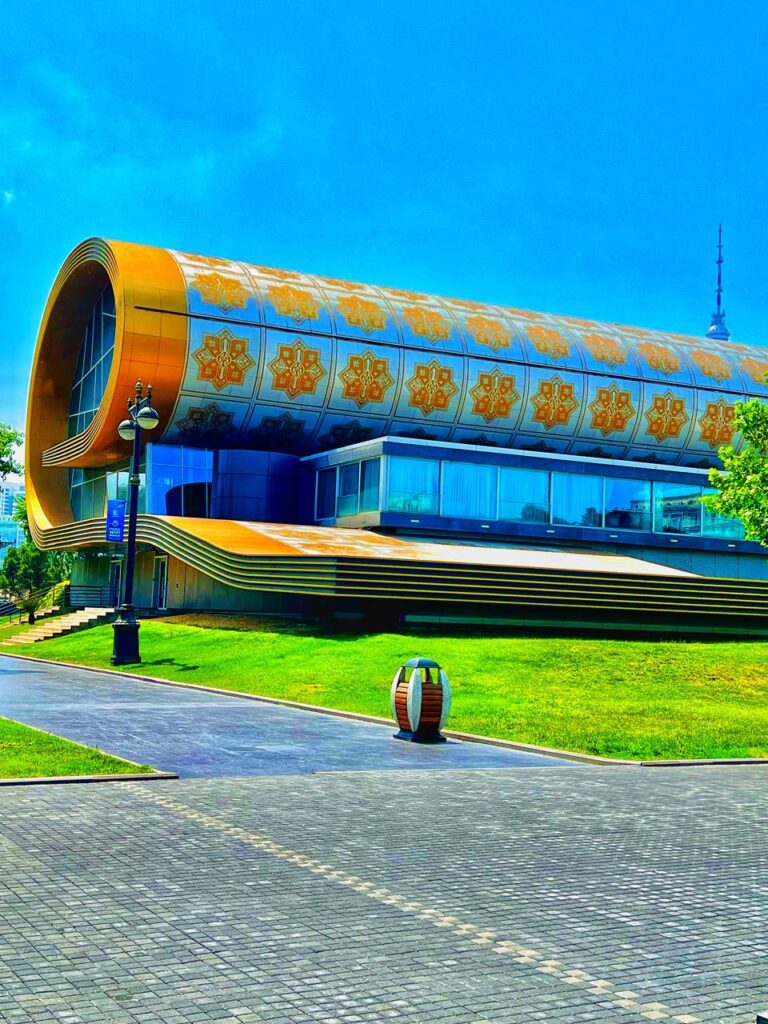
Our next attraction was visiting Azerbaijan Carpet Museum, located along the Caspian Sea Boulevard with the museum’s structure itself is an architectural masterpiece, designed to resemble a rolled-up carpet. The design is bound to attract any tourist. Inside, there are incredible collection of Azerbaijani carpets, highlighting the artistry, history, and tradition. Azerbaijan carpets are one of the richest in the world. It has got audio guide with headset inside with 6 languages and guides while walking through. The museum’s exhibitions provided the developments over time of Azerbaijani carpets and insight into the techniques of carpet weaving, a true symbol of Azerbaijan’s artistic legacy.
The carpets are made of wool, silk, cotton and woolen carpets are more expensive and last longer We had taken a relaxing stroll along the Baku Boulevard near the Carpet museum. The scenic promenade along the Caspian Sea is perfect for unwinding with some big ships floating in the sea with beautiful views all around.
Little Venice and Baku Boulevard:
One of the highlights was visiting Little Venice, a charming section of the boulevard that features canals with gondolas and picturesque small bridges, offering a peaceful relaxation in the bustling city. It can be called as romantic place with a serene boat ride through the canals, enjoying the cool breeze and the view of the nearby Flame Towers. The entry is free inside the park and one has to pay for the boat ride costing 5-8 Manats are for about 15-20 minutes. The area around Baku Boulevard is also home to several cafes and restaurants, where one can stop for a drink or Azerbaijani or western cuisine, while enjoying the surroundings. We had our lunch at one Azerbaijani restaurant at the city center and the design and decorations of the restaurant had Azerbaijani style. Found one bus full of tourists landed for lunch here and could sense their excitement seeing the style of the restaurant.
HeydarAliyev Center:
The magnificent HeydarAliyev Center, located in the heart of Baku city, was our next stop after lunch. Designed by the world-famous architect ZahaHadid, this futuristic building made an amazing first impression to us. Its smooth, wave-like curves and flowing lines make it a stunning example of modern architecture and a key landmark in Baku. The building has no sharp corners—only curves. There are beautiful art sculptures around the center that add to its charm. I didn’t go inside because I’m not very interested in museums, but I saw in YouTube videos that the center hosts exhibitions, music events, and conferences. It also features a museum that showcases
Azerbaijan’s culture, history, art, and modern development. Visitors are especially impressed by the wide open spaces inside, which create a feeling of freedom and fluidity. Inside, you can see miniature models of Baku’s famous buildings, as well as luxury Mercedes cars used by President HeydarAliyev.
The entry fee is 15 Azerbaijan Manat (around 9 USD). The exhibits give visitors a good idea of the country’s progress and the vision behind this iconic building. Outside, the front area has large marble floors, big steps, and beautifully landscaped green spaces. I couldn’t help but admire Baku’s amazing architecture.
Old City (Icherisheher):
To truly experience Baku’s history, I visited the Old City, also known as Icherisheher. This UNESCO World Heritage site is a maze of narrow alleys, ancient buildings, and historical landmarks—
and there’s no entrance fee. Walking through its cobblestone streets gave me a real sense of Azerbaijan’s rich culture. There were small traditional shops selling handicrafts and souvenirs, and local cafes serving delicious local food.
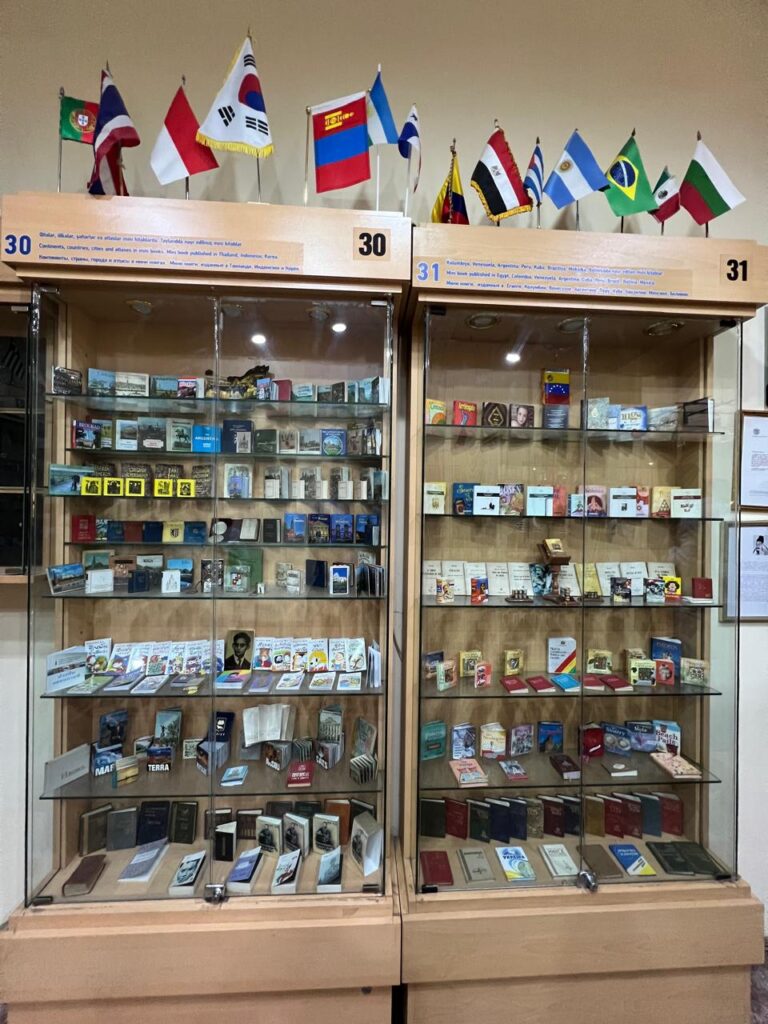
I first visited the Maiden Tower, a 12th-century monument with a mysterious history. After that, I went to a house that holds a huge collection of miniature books. This place is even in the Guinness World Records for having 2,913 unique tiny books. I found a miniature version of the “Hanuman Chalisa” in one of the glass cabinets. It also has the Palace of the Shirvanshahs, an ancient royal complex with impressive stone carvings, an old bathhouse, and stunning architecture. The entry fee for foreign visitors is 10 AZN. The atmosphere in the whole Old City felt magical, with a mix of centuriesold buildings and modern cafes, showing how Baku blends the past with the present. Baku city also has an underground metro system, which is not expensive and quite convenient.
Nizami Street: A Shopper’s Paradise with a Dash of Elegance: No visit to Baku would be complete without a walk down Nizami Street, Baku’s famous shopping and Pedestrian Street. The street is lined with boutiques, cafes, and shops selling everything from highend
fashion to traditional Azerbaijani crafts. The buildings along the street feature a mix of European
and Middle Eastern style architecture, making it a great place for taking photos.
As I walked along Nizami Street, I stopped by a few cafes to try local treats, including baklava
and Azerbaijani tea. The energy here is full of life, with locals and tourists alike enjoying the lively atmosphere. On the last day I bought some Azerbaijani sweets from this street to take back to my home, the shop ladies were friendly and let us taste the sweets before buying. However, when I got to the airport, I saw the same sweets being sold for much less. So, I realized I had paid a higher price on Nizami Street which the tourists always hate to face.
Day 3: A Spiritual Start – Juma Mosque of Samakhy We began our trip outside Baku the next morning with a visit to the Juma Mosque in a city called Shamakhy, in Azerbaijan. From my research, I found that this old mosque, with its beautiful architecture and huge courtyard, has a rich history. Entry is free, and ladies are provided with scarves to wrap around at the entrance. It is one of the first mosques in Azerbaijan built after the Arab occupation, constructed in the year 734 AD, and is considered the second oldest mosque in the Caucasus. The mosque has undergone extensive restoration and rebuilding, as it suffered significant damage during battles and earthquakes. This history is displayed on a marble slab at the entry point. Stepping inside and feeling the calming atmosphere we could feel the site’s elegance, tranquility and Azerbaijan’s rich Islamic heritage. It is still an active mosque, and when we visited in the morning, there were only a few people inside. The interior was covered wall to wall with carpets, and beautiful lights in three circular tiers of different diameters hung from the ceiling, glowing softly. Stepping inside and experiencing the calm atmosphere, we could truly feel the site’s elegance, tranquility, and the depth of Azerbaijan’s Islamic heritage.
The Majestic Seven Beauties Waterfall From the spiritual heart of Baku, our journey continued to the natural wonders of Azerbaijan.
Our second stop on the same day was the Seven Beauties Waterfall, located around 4 kilometers from the town of Vandam, high in the Caucasus Mountains near Gabala. It is a series of seven cascading streams flowing down the mountainside in seven different rock stages, hence the name.
The hike to the waterfall was an experience in itself. We had to climb about 400 meters from the car park through lush green meadows and rocky terrain. I could feel the fresh mountain air as I climbed with an umbrella in hand on that rainy day. When I finally reached the first and second waterfalls, I was greeted by the stunning sight of crystal-clear water tumbling down the mountainside, surrounded by unspoiled wilderness. The view, framed by towering cliffs and wildflowers, was mesmerizing. I spent some time standing on a wooden bridge with iron railings near the waterfall, soaking in the tranquility and reflecting on the beauty of Azerbaijan’s natural landscapes.
To reach the higher waterfalls, one must climb narrow, rocky steps. While expert hikers might enjoy the full hike, it wasn’t easy for an average tourist like me. I saw a few tourists going close to the base of the waterfalls, hopping across rocks to cross the flowing streams. However, after a long journey from Baku and with the rain making things more difficult, I decided not to go beyond the first two waterfalls and saved my energy. Even so, the experience was truly rewarding. Tufandag Resort & Cable Car Ride – A Thrill in the Mountains
After having lunch in one restaurant named as Malabar which had good Indian food items available, we went to the Tufandag Mountain Resort huddled in the northern part of Azerbaijan, close to the town of Gabala. Tufandag is famous for its ski slopes, snowboarding, and hiking, making it one of the most popular destinations for winter sports enthusiasts. But even in the summer, the resort offers incredible views and thrilling activities, especially if you love the mountains.
The highlight of my visit to Tufandag was, without a doubt, the cable car ride and the surrounding mountain scenery. As I ascended the mountain, the views grew increasingly spectacular. The cable car took me high above the mountain, where I could see the lush green valleys below, dotted with tall trees and few small villages. The sight of the cloud covered peaks in the distance was awe-inspiring. At the top, I had the chance to enjoy the panoramic views of the Caucasus Mountains, which stretched out in all directions, a breathtaking reminder of the vast beauty of Azerbaijan’s landscapes.
While riding the cable car of Tufandag, I got down in two different stops of the cable car for some time to enjoy the cool mountain air and snapping a few photos of the valleys below. Being fond of mountains and greenery I enjoyed this visit immensely. We had snacks & tea/coffee at one of the mountain resort cafes with intermittent rain covering the resort. I think for tourists like me 2-3 hours are enough in the summer time for this attraction.
Nahur Lake – Serenity amidst the Mountains After the adventure at Tufandag, our next stop was the tranquil Nahur Lake. The drive to Nahur Lake was an experience in itself, as we wound through winding mountain roads that provided panoramic views of the surrounding valleys. Upon arriving at the lake, I was immediately struck by its stunning and calm scenery and serene atmosphere. I spent some time walking around the lake, taking in the peaceful atmosphere. If you’re looking for an escape into nature, Nahur Lake offers just the right kind of retreat
– serene, beautiful, and untouched by mass tourism. This lake has a maximum depth of 24 meters and is a hidden gem located in the foothills of the Greater Caucasus Mountains. This stunning lake, surrounded by majestic peaks and dense forests, is a place of peace and quiet – a perfect spot for nature lovers. I read that Nahur is a manmade lake created after the World War 2 for the purpose of providing water to the surrounding villages. The fresh water sources coming from the mountains of Caucasus feed this clear, fresh water lake and it had lots of boats decked up for tourists, but on that rainy day, we decided not to venture in the lake. Normally one hour is enough for this lake.
After a day of natural exploration, it was time to head to Sheki, a town known for its rich history, beautiful architecture, and scenic surroundings. The drive to Sheki for about 95 kilometer was long but incredibly scenic, with the road winding through charming villages, green valleys, breathtaking mountain landscapes and many old model Mercedes cars on the way. As we drove further into the countryside, I could feel the sense of calmness and peace in tune with nature.
Upon arriving in Sheki, We checked into a cozy hotel at the town center that had its own charm– traditional yet comfortable. After settling in, I had a small walk around the quiet streets of Sheki after the daylong travel exploring the rich historical cultural heritage, dramatic mountains, tranquil lakes, and modern marvels. It looked like a nicely preserved city having history, its distinct architecture and gave us a different picture of Azerbaijan in comparison to the modern and developed Baku.
Day 4
We started from our hotel at Sheki in the morning, entered the area near the town with the small narrow lanes, in our first stop of the day being Kish Albanian temple, a historical landmark. It is also known as Church of Kish. It is an inactive church of 12th or 13th century ancient Albanian church located in the village of Kis about five kilometer from Sheki. It is surrounded by legends and mystery.
We paid a small entry fee in the rainy morning and could feel the age and the historical vibe on entering. Only few visitors were there in the rainy morning with a tranquil atmosphere and needs only few minutes to travel.
Next we visited a masterpiece of 18th-century architecture, the Sheki Khan Palace located on
the outskirts of Sheki city which served as the private summer residence of the Khans. It is an UNESCO World Heritage Site officially named as Historic Center of Sheki with the Khan’s Palace and is Sheki’s biggest attraction. It’s a jewel of Azerbaijani craftsmanship, famous for its colourful stained-glass windows (local name – Shebeke), ornate woodwork and detailed murals. It has entrance fee of around 5.5 USD to get inside. One does not require a ticket to enter the courtyard and photos of the palace can be taken from the courtyard as one wishes. It is inside the walls of Sheki Castle at the top of a slope which is a fortified complex having several museums and open every day from 9 AM until 6 PM.
Karavansaray near Sheki, Silk Road town The stone-built historic caravanserais (meaning roadside inns providing lodging for travelers, merchants and courtyard providing accommodation for caravans overnight) were once an essential stop for the Silk route merchants and acted as crucial hub for the trade network. These are now a tourist attraction offering the visitors a glimpse into the past. It has arched corridors, large inner courtyards, traditional decorations and many of them are converted to hotels or cultural centers. These were strategically placed along the routes so that travelers could rest for the night in a safe, convenient place, with some offering fortified walls to protect them from bandits or other type of dangers. They were crucial for exchange of ideas, religions and customs between people of different cultures and travelers could dine under the stars. The one we visited near Sheki had heavy wooden doors, restaurant and liked the impressive architecture with stone arches and the central courtyard with greenery, walkways and a beautifully designed water fountain.
Street of Sweets and Potteries – Sheki Next we visited the row of shops which are boutique shops and antique emporiums in the main street near the Caravanserai. We found shops and workshops selling traditional Azerbaijani sweets and some handcrafted ceramics and copperware. We also found the souvenir shops selling traditional silk scarves. I came to know that Kelagayi are traditionally worn by Azerbaijani women to cover their heads and Sheki is also a place which is famous for its Kelagayi making.
Bio Garden- Next we had plan to explore Azerbaijan’s Bio Gardens—eco-tourism farms that focus on organic agriculture and sustainability and these green sanctuaries are perfect for reconnecting with nature. For heavy rain we decided not to visit this one. Back to our hotel at Baku in the evening.
Day 5:
The day started with a trip to Mud volcanoes. Our tourist car did not take us to the actual site of the mud volcanoes and we used another rugged jeep provided by our tour company with fully blasted Azerbaijani music took us for about 15 minutes through the bumpy off roads. Azerbaijan has highest concentration of these volcanoes in the world and many of them are located in Gobustan National park.
The mud Volcanoes are unique natural geological formations that erupt gas and mud. The open landscape was big, dotted with dozens of cone-shaped, grey mounds and feel like those were gurgling with cold, thick mud.
These are not hot like lava from the volcanoes. Some were bubbling quietly, others suddenly spat out gas with a dramatic hollow gurgling sound. I couldn’t resist dipping a finger and felt the cool, silky mud which is said to have healing properties. Out driver struck a lighter at the gas emitting out and it caught fire for few seconds. It’s oddly relaxing to watch the earth breathe like this and quite new experience for us.
Gobustan:
We had our next stop at The Gobustan Museum, just at the entrance to the site of Gobustan National Park, provided a modern and interactive prelude with Touchscreens and projections brought these ancient artworks to life, illustrating how early humans lived, hunted, and possibly even worshipped.
The entry ticket we bought was for both the museum and the Gobustan National Park.
Next we headed to Gobustan National Park, located about three minutes’ drive on a hilly road
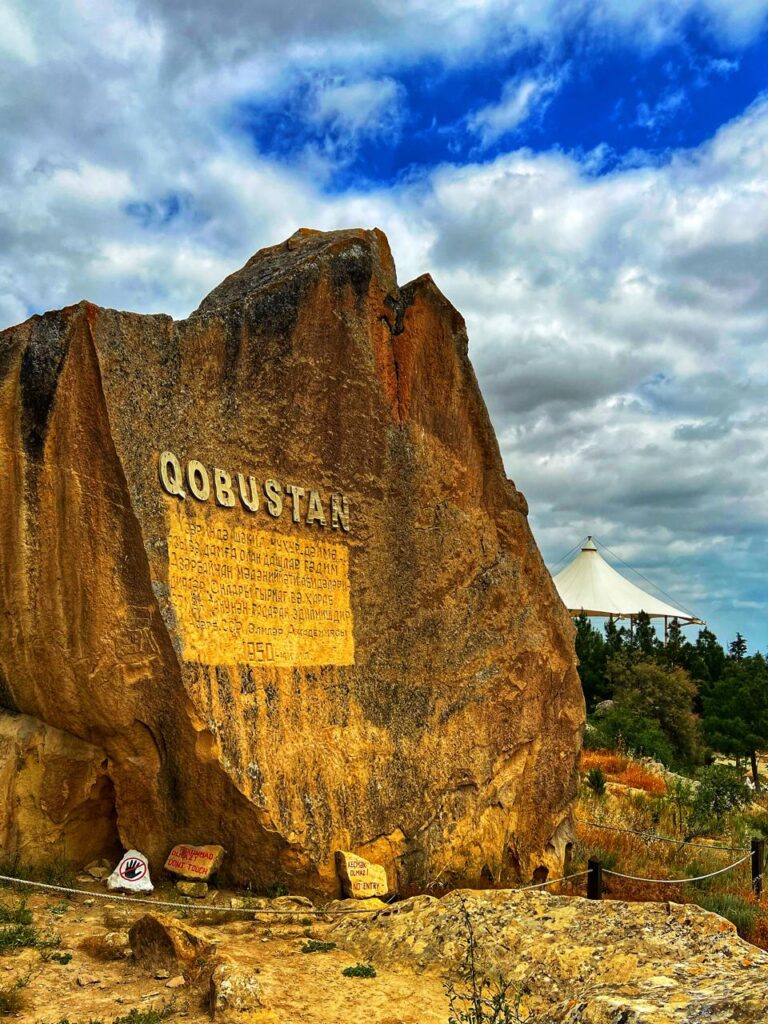
from the Museum. This pedestrian only UNESCO World Heritage Site is rich in archeological monuments and home to more than 6,000 Rock engravings made on the rock using a stone, chisel and hammer stone (in scholarly texts called petroglyphs), some dating back from nearly 5000 – 40,000 years. It feels surprising that this barren rocks cape now, some are in the shape of stone caves was bustled with tribal life at one time. There were walking spaces between the huge rocky hills with rock engravings in some stones and signboards described the arts. Liked some of the unique designs of the big stones hanging at the sides of the hill and could not resist taking photographs. Found government is trying to boost tourism and well maintained wash rooms were available.
Bibi-Heybat Mosque: A Peaceful Interlude On the way back toward Baku, we stopped at the majestic Bibi-Heybat Mosque. The existing structure was rebuilt in the 1990s over a 13th-century original structure mosque destroyed by the Soviets, this spiritual sanctuary overlooks the Caspian Sea and holds the tomb of UkeymaKhanum, a descendant of the Islamic Prophet Muhammad. Today it is a center of spiritual importance for the Muslims of the region and one of the major monuments of Islamic architecture of Azerbaijan. Beautiful Golden domes near the roadside shimmered in the sun, and felt the silence inside and found some offering quiet prayers. It was a moment of stillness and the silent atmosphere inside that contrasted beautifully after visiting the rugged wildness of Gobustan. Enjoyed the view of the Caspian Sea from the front side of the mosque.
Ateshgah: The Fire Temple of the Zoroastrians After lunch we proceeded to Ateshgah, the Fire Temple of the Zoroastrians having historical importance, just outside Baku. Originally it is said that eternal flames that once vented from the ground here due to natural gas seepage drew attention when fire was worshipped as symbol of God’s light and divine by the local people. It was once a pilgrimage site for Zoroastrians, Sikhs, and Hindus and some inscriptions in Sanskrit and Punjabi still remain on the walls signifying the historical connections between Azerbaijan and the Indian subcontinent. Today, the flame is kept alive artificially, but the aura of mysticism
is still there. While walking through stone-walled chambers saw pictures of ascetics meditating, Nataraj and some recoded voices in the flickering light centuries ago. Yanar Dag: The Mountain That Burns The journey culminated in a place that quite literally lives up to Azerbaijan’s nickname: Yanar Dag, or the Burning Mountain. As evening approached we reached a hillside just outside Baku where flames erupted continuously from a seam in the earth. The fire keeps on burning across about ten-meter stretch of hillside and is unaffected by wind or rain. It’s been burning for decades – maybe centuries and no one truly knows how long. Watching the flames burning through the hill, I could visualise why this country was once considered as sacred to fireworshippers.
Besides being a country of oil and innovation. It’s a place where the earth still speaks — in symbols, in fire, in silence – and all you need to do is listen. Candy Cane mountain, Red village, Shahdag Resort, cable car, Zip line, Alpine Coaster activities, Canlibenlake, Garcresh Forest, Guba
Day 7
We started from Baku in our last day trip at Azerbaijan next day morning to Shahdag mountain resort. Passed through Guba (Quba), a beautiful town on the way and had scenic picturesque views with greenery all around on the way to the Shahdag Mountain resort. In some places, found a river flowing by near the road and added to the natural charm and we took pictures of the beautiful landscape.
Shahdag is called as Switzerland of Azerbaijan by some has beautiful green mountains on both sides of the road. In winter snow flakes are seen on the mountains. We could feel the cold as soon as we got out of our car at this beautiful big mountain resort covering a big area. This beautiful resort has many activities like Zip line, Paroplan, Bobcart, Kvadro, Zorbing, Trampoline, Paintball, shooting, Sigway, Horse riding, Go cart etc. By visiting the information center and ticket counter one may plan accordingly.
Mountain roller coaster is one of the main attractions here. If two of the passengers together weigh more than 140 kilograms, they have to take a single roller coaster. They charge 20 Manat per person and 35 Manat for two persons to ride together. I came to know that this trip is more than 2.5 km long, it goes 920 meter uphill and about 1600 meter downhill. The thrilling part is the downhill ride, sliding down the mountain top with curves through the green mountains. We found the place to be quite cold even in the summer time. The Ropeway or Gondola is also very popular. It has glass cover at the front of the cabins to save one from the cold, but the feet gets exposed to the cold outside. There is one stop at the middle where one can go out of the cabin to take photographs.
We visited Canlibenlake while coming back from the Shahdag mountain resort which is a popular destination for its picturesque peaceful scenery with lush green surroundings and is ideal for relaxing walks and picnics. Saw one hotel and spa as Lake Park near the lake. Saw some boats in different colour were ready for the tourists and few families enjoying the ride at the beautiful lake. Next we passed through Gacresh forest which has a lot of restaurants on either side of the road.
This stunning place has tall green tress at both sides of the road and at some places completely encompasses the road at the top looking stunningly beautiful and hence a popular spot for taking photos by the tourists and you tubers. We had lunch at one such beautiful restaurant on that rainy day surrounded by greenery all around with one small water body. Roads have beautiful panoramic views with greenery all around on the way to the Shahdag Mountain resort with a river flowing by near the road. Shahdag is called as Switzerland of Azerbaijan by some with beautiful green mountains on both sides of the road.
In winter snow flakes are seen on the mountains. Candycane mountain is at around one and half hour drive by car from Baku city on the way to Shahdag mountain resort. This mountain looks abnormal and has unique red and white stripe colour without any greenery and looks like a candy and it is named so. On the 8th day morning we returned back to Muscat via Arabian Airlines to Muscat with a change of flight at Sharjah. We will remember this country where mountains, deserts, and the sea coexist so harmoniously. Whether one is a history lover, a foodie, or an outdoor adventurer, Azerbaijan invites all to explore, connect, and discover the contrasts it offers.
Bharat Bhusan Kalita
Phone no:7577892081