
As India marches toward mid-century, its energy landscape is poised for dramatic transformation. The nation’s burgeoning appetite for power – driven by rapid industrial expansion, urbanisation, and rising living standards – will inevitably collide with global climate commitments and the urgent need to reduce carbon emissions. At the heart of this transition lies a critical question: what role will hydrocarbons – coal, oil, and natural gas – play in India’s energy future?
India’s current energy landscape reflects its position as a major power in the Global South. India’s energy consumption has risen in tandem with its economic stature, cementing its position as both an engine of global demand and a laboratory for ambitious transitions. In 2025, the nation’s total primary energy supply hovers near 1,800 million tonnes of oil equivalent (MToE), expanding at about 4.5% a year. Even as energy intensity (energy used per unit of GDP) steadily declines due to efficiency gains, hydrocarbons remain the bedrock of this supply.
Present demand-supply patterns highlight the evolving energy mix.
•Installed power capacity (mid 2025): roughly 476 GW with thermal (coal + gas) ~240 GW and non_fossil ~236 GW (renewables + nuclear), making non_fossil ~49% of capacity.
•Electricity generation mix (2024–25 provisional): renewables’ generation share rising (~22% of generation) but coal/thermal remain the main generation source by energy produced.
Indicative 2024/25 energy capacity and generation snapshot
Metric Value
Total installed capacity 475–476 GW
Thermal capacity ~240 GW (50.5%)
Nonfossil capacity ~235 GW (49%)
Coal is the unmistakable giant, responsible for nearly half of the mix, followed by oil and gas. While the total electricity generation capacity has reached 476 GW, with nearly half attributable to renewables, coal plants run more consistently and thus remain the backbone of India’s round-theclock power supply.
The energy demand profile reflects the country’s development: industry and services consume the lion’s share, followed by transportation and then residential/agricultural demand. Government flagship schemes, such as universal LPG and city gas distribution, have resulted in tremendous gains in energy access, with over 99% of villages now connected to the power grid, though challenges around supply quality and affordability persist.
Looking toward 2050, the future of India’s energy demand underscores the trilemma of growth, sustainability, and security. Projections by NITI Aayog, TERI, and the IEA suggest that total energy demand could nearly triple to around 5,400 MToE. This surge will be driven by demographic growth, urban expansion, industrial diversification, and emerging energy-intensive sectors such as electric mobility and digital infrastructure. By 2030, non-fossil sources—mainly solar, wind, large hydro, and nuclear— are expected to provide over 62% of installed generation capacity. However, hydrocarbons will remain indispensable, supplying nearly half of the energy actually delivered, owing to their reliability and ability to meet baseload needs.
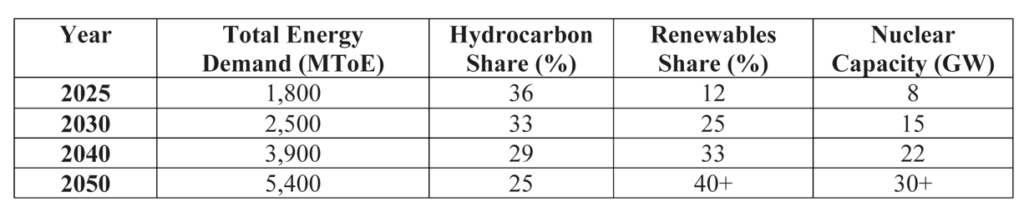
Hydrocarbons continue to define India’s strategic energy choices, with coal, oil, and natural gas each presenting distinct opportunities and challenges.
Coal embodies the country’s security-versus-sustainability paradox. With over 378 billion tonnes of proven reserves, coal provides affordable, domestic energy and shields the country from external supply shocks. Yet, the environmental costs are high—coal-fired power plants remain major sources of air pollution. The government is investing in cleaner technologies to retain coal’s strategic benefits while curbing its emissions impact.
Natural gas plays the role of a cleaner bridge fuel. Although it remains a modest part of India’s energy basket, the government aims to raise its share to 15% by 2030 through major investments in LNG terminals, cross-border pipelines, and city gas distribution networks. However, challenges of pricing, accessibility, and infrastructure continue to slow progress.
The expanding role of renewables and nuclear energy marks India’s most dynamic shift. The country now ranks among the top three solar power producers globally, with solar capacity exceeding 110 GW and wind nearing 51 GW. Falling solar tariffs have boosted clean energy’s competitiveness. Nuclear energy with low carbon footprint, is also gaining momentum. The Nuclear Power Corporation of India plans to expand domestic sites, targeting over 30 GW of nuclear capacity by 2050.
The economics, geopolitics, and equity dimensions of India’s energy strategy are closely
intertwined. Falling renewable costs on one hand and volatile oil prices on the other are reshaping global energy scenario. India’s goal of 500 GW of non-fossil capacity by 2030 has drawn record investments, yet the sector still faces a huge financing gap for generation, grid, and storage expansion. Energy security now depends on affordability and resilience to global shocks. The backdrop of war, supply chain disruptions, and volatile markets underscores the urgency of expanding strategic oil reserves and refining capacity. In this regard the Government of India has set up Indian Strategic Petroleum Reserve Limited (ISPRL) with total capacity of 5.33 Million Metric Tonnes (MMT) at 3 locations, namely Vishakhapatnam, Mangaluru and Padur.
India’s stance in global climate negotiations reflects a balance of ambition and fairness. The country has pledged net-zero emissions by 2070 and to halve its emissions by 2030, while asserting the equity principle—that developed nations with high historical emissions must shoulder a larger share of carbon reduction costs. For India, the priorities remain poverty eradication, reliable energy delivery, and sustainable growth without sacrificing future prosperity. As it navigates this transformation, managing the human side of the clean energy shift becomes crucial.
Innovation is emerging as the final pillar of India’s energy transition. The country’s participation in the ITER fusion project and the development of its own SST-Bharat reactor demonstrate its long-term vision for a post-fossil era powered by technologies like green hydrogen, advanced storage, and AIoptimised smart grids.
Ultimately, India’s hydrocarbon story is not about holding on to the past but about pragmatically managing the present while preparing for the future. Coal, oil, and gas will remain vital for the next few decades, but the transformation is already underway in solar farms, wind corridors, nuclear sites, and fusion labs. With strategic foresight, innovation, and global cooperation, India can not only secure its own growth but also serve as a model for the developing world—showing that prosperity and sustainability can advance hand in hand.
Rupashree Borthakur
Phone no: 9968282294