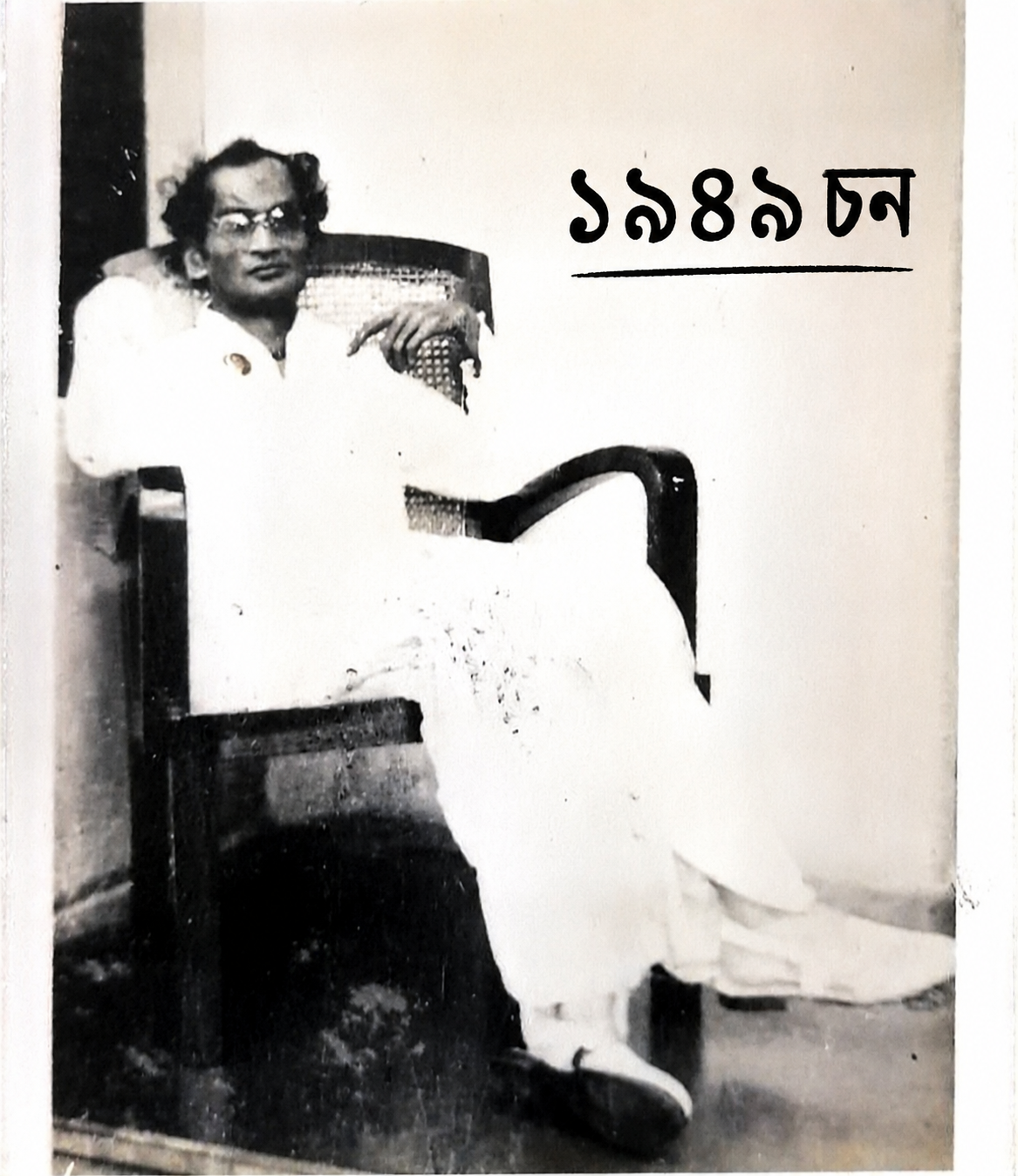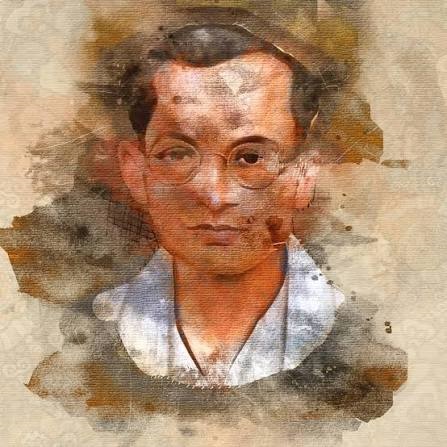
Jyotiprasad was a keen observer of cinema, a practitioner of music and a voracious reader. While in the UK and UFA in Berlin, he was fairly influenced by the Russians, by the German impressionist style of filmmaking, and partly by Franz Osten. Long before he had planned to make his film Joymoti and he meticulously mentioned the flaws of Indian talkies in the 1930s. He saw that they were exclusively based on melodrama and music. Jyotiprasad strongly believed that the uniqueness of Assamese culture could be portrayed in a worthwhile manner only through films.
A voracious reader and a lover of music and cinema, particularly Russian cinema, Jyotiprasad believed that meaningful cinema could be a tool to showcase the culture of a nation. He read books like Film Problems of Soviet Russia (1922) by Bryher. This book narrates on many aspects of Russian cinema and focusses on Lev Vladimirovitch Kuleshof, Eisenstein, Pudovkin, Alexander Room, the sociological film and the problems of Russian films. Bryher mentions that Vsevolod Pudovkin’s silent film, The End of St. Petersburg (1927) was made to commemorate the tenth anniversary of the October Revolution. It is a political film that covers the period from about 1913 to 1917 and explains why and how the Bolsheviks came to power in 1917. Instead of focussing on the political figures of the time, the film portrays the struggle of ordinary people. Again, Bryher refers to Sergei Eisenstein and Grigori Aleksandrov’s silent film October: Ten Days That Shook the World. Made in 1928, it is a historical film that showcases the celebratory dramatization of the 1917 October Revolution.
The Russian method of depicting the socio-political scenes in the films inspired Jyotiprasad who later used social realism as a narrative technique for his film Joymoti. A new cinematic language was scripted. Jyotiprasad chose non-professional actors and actresses for his film and selected the artist with utmost care. He was particular and meticulous in the selection of the artists and said that that only ‘Types’ were selected for his films following the Russian method. Jyotiprasad wrote, ‘The picture as contemplated will be a new move in India. No professional actors and actresses are recruited. All artists are scrupulously searched and discovered and only ‘types’ are selected following the Russian method. All girl artists are recruited from respectable families.’4
Jyotiprasad was in constant touch with K.D. Mehra. Jyotiprasad mentioned to him that the story of his film was “wonderfully interesting” and believed that his film would be “one of the most romantic stories ever filmed in India’. He mentioned that he wanted to present the film from a realistic point of view rather than in a theatrical way. He was clear in his approach in making the film; his approach would be the “Russian method” of direction. He stated that his film would be ‘different from other Indian films’.
The cinematic treatment of Joymoti was different from the rest of the Indian films because Jyotiprasad himself said that the film had the distinguished characteristic of a first-class English, American and Russian film. His protagonist Joymoti was represented as a woman with patience and dignity, who spoke only whenever necessary. Reticence or bashfulness was a characteristic feature of an Assamese woman and Joymoti established that quality immaculately. Assamese women, while watching the film, could feel oneness with the character of Joymoti. Jyotiprasad said, ‘I paid minute attention to the normal way of speaking, the typical Assamese pattern and the usual mode of delivery used by Assamese people. I noted in detail the beauty and the peculiarity of speaking the Assamese language among the leading Assamese gentry as also among the common people, both male and female. A long period of 30 to 40 years of viewing translated Bengali dramas and witnessing Bengali films has made Assamese people forget the beauty of speaking the Assamese language in its own style. I particularly did this to make the upcoming Assamese generation aware of it. Unfortunately, only a small minority of the audience could grasp my intention and express satisfaction over it. Many even accused me of total ignorance about acting and dialogue delivery in films.’5
The film Joymoti begins with the Krishnasur (Krishna versus demon) dance. Lora Raja, Lalukxula Borphukan, Gathi Hazarika and ladies of the royal family are enjoying the Krishnasur dance. The Krishnasur dance, taken from the traditional folk drama bhaona, was performed in the Ahom royal court to suggest allegorically the triumph of good over evil. The filmmaker Jyotiprasad justified the reason for representing a scene from an epic. He says in the article titled, “Why the dance of Krishna-asur (demon) has been incorporated in the film” that Krishna is the symbol of eternal beauty of human civilization. The demon is the ugly face of social evils. There is a continual clash between these two forces on the path of human progress. In the film Joymoti an unusual clash between culture and social evil (anti-culture) is highlighted. On one hand, the power hungry, warmongering, atrocious Laluk Barphukan proceeded to celebrate hispolitical achievements with his evil designs and inundated the entire state with his lawlessness and injustice and, on the other hand, Joymoti, the unique symbol of the state’s cultural power, stood up to counter this single-handedly. The introduction of the Krishnasur (Krishna versus demon) dance as the curtain raiser is used as prologue of this dramatic clash. In this dance, following a violent standoff between the civil cultured force and the evil powered culture is shown to triumph finally with the certain death of the Asur (demon) in the hands of Krishna.6
Thanu Ram Borah, who played the role of the Asur in the Krishnasur dance, reminisced that his co-actors, Phunu Barua and Swargajyoti painted him with blue colour. Jyotiprasad told him to dance in a confined space and make a movement of his eyes with his mouth wide open staring at the camera which was fixed at one point. In an extreme close up shot, the Asura is seen moving his eyes. Jyotiprasad disclosed his inspiration, “I saw an actor moving his eyes in a German film for the first time and probably, I would see it for the second time in my film.”7
Jyotiprasad had a fair knowledge of the intricacies and complexities of this new medium and he used cinema as a cultural tool rather than as a form of entertainment. National award-winning author and film critic, Apurba Sarma writes in detail about the cinematic beauty of a sequence in the film Joymoti.
‘The sequence in which Joymoti, summoned by the king, prepares to leave for the royal court. Without using a single dialogue, Jyotiprasad shows Joymoti, suppressing her complex feeling of hurt and indignation, dresses up in her bridal best and entering the prayer room kneels down in a silent prayer as she possibly foresees her doom, and then moves out of the house – serene, dignified and graceful as a few old ladies in the family silently weeps, bidding her farewell…in another masterly composition as Seuti, the royal maid, disguised in a man’s garb, goes out for a tryst with her lover, the camera pans catching her tilt image in the water of a pond as she moves along the bank and then tilts up to focus the normal image of the lovers meeting together on the edge of the pond. An ordinary scene was transformed into a refreshing experience by the intelligent and tasteful use of the film language’.8
Franz Osten’s silent film Shiraz (1928), an Indian/British/German co-production, and the second of three silent films made on location in India featuring Himansu Rai, begins with a scene where a caravan, laden with riches, is shown crossing the great Persian desert and entering a gorge. One of the bandits on horseback at the crest of a hill is shown from a low angle spotting the arrival of the caravan, signifying the power of the bandits. In a similar fashion, Jyoti prasad composed with a low angle shot when Seuti, the royal maid, masqueraded in a man’s apparel, rode with her lover Dilihiyal Gohain on horse-back and reached the crest of a hill. The filmmaker deliberately used this frame composition to insinuate larger-than-life figure that gives a subconscious impression to the viewers that Seuti is strong and formidable. She fought with her sword single-handedly against the King’s men and trounced them.
A filmmaker with modern and progressive ideas, Jyotiprasad constructed the images of woman as strong, dominant and formidable, and not in their conventional roles as submissive and passive. In the 1930s, majority of the films made in India seemed to define womanhood in a confined and traditional manner. Jyotiprasad’s depiction of his two major female characters– Joymoti and Seuti has different shades that obliquely bear the essence of Assamese culture, history and social values. He attempts to liberate women from the constraining stereotypical moulds through the representation of strong women. In the film, Joymati never disclosed her husband’s whereabouts even after she was tortured for fourteen days continuously before she succumbed to death. Her sacrifice is not glorified in the film as the wife of Godapani, but an individual entity who laid down her life for the welfare of the country. She is presented as a symbol of supreme sacrifice for her country. Joymoti’s silent but strong protest the cruelty of the puppet king, Lora Roja made the film a strong statement on female power. If Joymoti’s silent protest is a metaphorical representation of female courage and resilience, Seuti, the royal maid’s fight with the King’s men and her ultimate victory, is suggestive of the valiant quality of Assamese women.
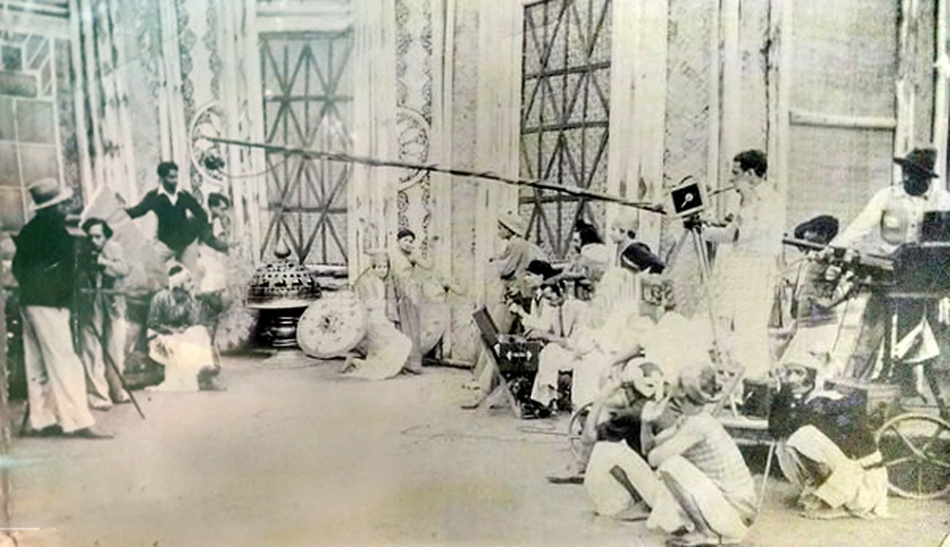
Jyotiprasad methodically researched the subject, discussed it with the historians and scholars and visited the Sattras. The setting of the film had to be designed to represent the 17th century Ahom royal palace. No one could provide the actual picture of the houses and interiors of the Ahom kings who ruled Assam for more than six hundred years. He designed the settings of the Ahom royal palace with bamboos, banana stems for his film, and it looked like an authentic Ahom royal palace that was vividly brought to life.
The Japi, made of tightly woven bamboo or sometimes cane, is predominantly used in the film as the symbolic representations of cultural identity of the Assamese people. Originally, the Japi was used as a headgear for protection from the heat of the sun and from the rain by the farmers. But the decorative Japis are worn and used by the royal families in Assam. The Japis are considered as symbols of honour and forms of representation of the Assamese cultural identity. In the film, Jyoti prasad who himself was the set designer, decorated the walls of the royal court with the traditional Assamese Japis. Jyotiprasad used dance sequences with Japis in the film where a group of people with the japis are seen dancing with joy. He made an attempt to popularize the indigenous Japis throughout the country. Interestingly, in the film, Jyotiprasad himself danced in the scene of the Japi dance.
Another predominant use of the Assamese traditional symbol is the bell metal and brass objects such as xorai, banbota. The Xorai is, in fact, an offering tray mounted on a base that is placed in front of the manikut in the Naamghar (prayer house) soliciting the blessingsof God. The heroine, Joymoti was seen praying in her goxai ghar (prayer room in the house) just before proceeding to the royal court. Jyotiprasad shows the xorai in the foreground of the frame and Joymoti at the backdrop.
Jyotiprasad reconstructed a typical Naga village in the Kharghuli hills of Guwahati, and in the film, Godapani meets Dalimi there during his absconding period. Dalimi is presented as a buoyant, blithe and merry-making girl who enjoys Godapani’s company. Jyotiprasad used the songs as a trope to define the meaning of love, reflecting Dalimi’s vigorous and carefree nature and depicting many shades of life. The songs Lora Burha Kak Koi/ Dalimiye nabuje taak and Botah Hale Jale, featuring Dalimi and Godapani, cast a magic spell with both music and visuals. In the 1930s, Indian cinema found the sound with the film Alam Ara (1931), but the notion of playback singing seemed to be still lingering at some distance. As there was no playback singing, Jyotiprasad recorded the songs live with the accompaniment of the piano and organ. The shooting was done with a camera that recorded the sound directly on the film. In an interview with Babul Das for his book Jyotir Sannidhyat, Parshuram Barua (Phunu) said that after the shooting at Kharghuli, while returning to Bholaguri over the Brahmaputra River by ship, Jyotiprasad was enthralled by the magical reflection of sunshine on the water. Instantly, he composed a song Luitore Pani Jabi O boi/ Xandhiya Luitor Pani Xunuwali…and composed its tune instantly. Later on, he incorporated the song in the film. They were the most widely popular songs that still continues to inspire the new generations. In the same interview, Parshuram Barua said that the film ends with the song Luitore Pani Jabi O boi, but unfortunately, when the shooting was over, the quality of the song was found to be very poor. This interview with Parshuram Barua clearly proves that the song Luitore Pani Jabi O boi was in the first version of the film, but later, in the edited version, the song was newly sung by Arati Sharma.
Jyotiprasad introduced imagery and suggestiveness at some climactic junctures of the film. He used the animal image to reflect the emotions of the characters. In one scene, when the King summoned Joymoti to the royal court, the feelings of the villagers as well as her grief were beautifully articulated with cinematic beauty. Jyotiprasad used an extreme close-up shot of an elephant’s eye to create an intense emotional atmosphere. Dalimi’s vibrant nature is compared with the deer shown in her courtyard while the bear and the hornbill are used on various occasions. These visual motifs in the film establish his directing prowess as a filmmaker.
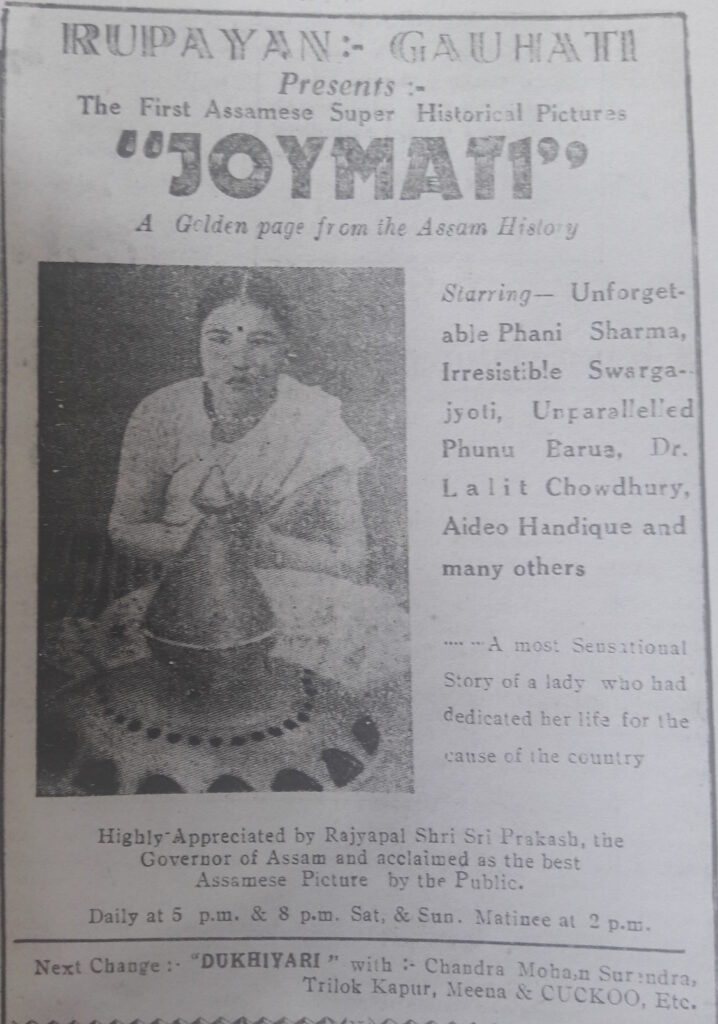
As a filmmaker, Jyotiprasad took all pains to transform the non- actors and shape them specifically to look, talk and express themselves as the respective characters in which they were cast. Aideu Handique, the protagonist of the film, had never faced a camera in her life or acted before. She was moulded and transformed into the character by Jyotiprasad. Aideu said that Jyoti Kokaideu (brother) was like a father figure for her who taught her in detail the inner meanings of a scene, how to walk, how to speak, how to look sad or happy. She said, “Jyoti Kokaideu told me that Lai-Lesai (names of the two sons) would be snatched away from my bosom. He asked me to feel as if they were my own sons and advised to express my emotions accordingly.”9She further said that “Jyoti Kokaideu did not use make- up on my face as the colour of my skin and face had a bright reddish glow”.10 She fondly remembers an incident while enacting a scene in the film where, according to the script, Phani Sarma who played the role of Gathi Hazarika, was supposed to beat her to make her disclose the whereabouts of her husband, Godapani. She recollects, “Phani Sarma was supposed to beat me… and to tell you the truth, he drank a little bit of wine before enacting the scene! I was a healthy girl, and it was only later that I felt the wounds. I cried and fell down, and then I was hospitalized for a week. I was not given any rice but only milk.”11
Swarga Jyoti Baruah, who played the role of Dalimi in the film, recollects how Jyotiprasad trained her for the challenging role. She said that Jyoti Kokaideu trained her how to laugh, to dance, and express sadness with minute details. One day, he demonstrated her dance steps by dancing in the front of a life-size mirror in a room and then went out. She then followed in his steps and practised over a long period of time all alone in the room. Next day was the shooting of the song Lora Burha Kak Koi, and she needed to perform the dance with the song. She was edgy and hesitant to dance before the camera. At that moment, Jyotiprasad approached her and whispered, “Dance, the way you danced yesterday before the mirror.”12
Jyotiprasad had his own technique of preparing his actors for shooting in his film, and at the advent of the training at Bholaguri, the director gathered the cast together at one place. This discussion gave them an intense and instant sense of the emotional dynamics and tone of the story. He discussed the role of each actor that provided an idea about how a role is created and why the character behaves in a certain manner in each scene. This discussion on roles, a method of a skilled director, produced many new aspects and ideas for the characters as well as for the assisting directors.
Recollecting the moment, Phani Sarma, who played the role of Gathi Hazarika, said, “After listening to the script, we had a pretty good idea about our roles. Back at our camp, we began to practise before the mirror with different facial expressions. Manubhiram Barua, who was said to enact a love scene with Seuti in the film, was practising before the mirror to express the language of love through his smile…” 13
Gajen Barua, who played the role of the king’s friend, discussed Jyotiprasad’s unique way of training the actors at the Bholaguri camp. Jyotiprasad set a fixed schedule for all the performers, and they were to follow accordingly. They had to wake up early in the morning for physical exercise and in the evening, they had to play different games. The most crucial thing was the actor’s rehearsals which, in fact, reflect the director’s vision. Rehearsals were performed three times daily. “Jyotiprasad taught some of the actors how to walk, stand and also the posture of sitting.”14
With the initial warm receptions from the audience across the state for the film Joymoti, Jyotiprasad developed a strong urge to make Hindi and Bengali versions of the film and accordingly prepared the scripts. But on the other hand, a section of people in Assam began to criticize the film vehemently for its sound quality. The poor sound in the film ruined an otherwise spectacular production. These criticisms disheartened Jyotiprasad to such an extent that he lost all his strength and enthusiasm to move ahead with the Hindi and Bengali versions. Besides, the film Joymoti, which was made on a budget of Rs. 50,000, had a loss of approximately Rs. 28,000. But Lakshminath Bezbaroa comments: “Film Joymoti, with all thy faults, I love thee!”
Phone no: 9435061618